Poor posture often leads to a rounded back, which is not only visually disturbing but also very stressful for health. Learn in this article how targeted exercises can correct your rounded back and prevent future postural problems. Discover helpful tips for a healthy spine and greater well-being – and how ergonomic office chairs can effectively support you in your daily life.
If you take a closer look at your surroundings, you'll quickly notice that many people – yes, even ourselves – generally have anything but an upright, straight posture that looks fit and healthy. Their heads usually droop forward and their shoulders are slightly hunched. Their upper backs often look more like a hump.
Anyone who thinks that a rounded back only affects older people is mistaken! Many young adults and even children struggle with it. In this article, you'll learn how targeted exercises can correct your rounded back and prevent future postural problems. Discover helpful tips for a healthy spine and greater well-being.
Previously, a rounded back (medically known as kyphosis) was primarily seen in older people. Today, many young adults and children also have a rounded back.
Rounded back, also known as a "hunchback" or "dowager's hump," is one of the most common postural defects. In most cases, it results from poor posture and lack of exercise, which then leads to the spine curving between the neck and upper back at shoulder level, causing problems (including severe back pain).
If poor posture is the sole cause of your rounded back, you can correct it with plenty of exercise and targeted exercises. In this article, we'll show you which exercises are truly effective and what else you can do to prevent a rounded back or get your spine back in shape.
What exactly is kyphosis – a rounded back?
Kyphosis refers to a backward curvature of the thoracic spine. A slight curvature of the spine is perfectly normal and even important for healthy posture (physiological kyphosis). However, if the curvature exceeds 40 degrees, it is called hyperkyphosis , colloquially known as rounded back or hump . Most often, the terms kyphosis and hyperkyphosis are used synonymously and both refer to the pathological change in the upper back.

How does a rounded back develop?
There are various causes for the development of kyphosis. Sometimes, serious illnesses are hidden behind a rounded back, such as:
- Rheumatic diseases of the joint and spinal system (e.g., ankylosing spondylitis, arthritis, and polyarthritis)
- Scheuermann's disease, a growth disorder of the spine in adolescents
- Osteoporosis (especially in older people). In this bone disease, the back can become deformed due to vertebral fractures.
- Trauma caused by accidents and other acts of violence in the area of the thoracic spine (T-spine)
- Tumors of the skeletal system
However, the most common causes of a rounded back are not "hard" medical reasons, but simply lack of exercise and postural defects .
We all move far too little or in a one-sided way. We sit all day at our desks, on our phones, or in the car in a rigid, forward-leaning posture.
This forward-leaning posture leads to muscle tension. The muscles in the front of the chest and abdomen shorten, while the shoulder and back muscles lengthen and tense. Medical professionals refer to this as muscular imbalances, meaning an imbalance of muscle strength.
Over time, this poor posture leads to changes in the vertebrae and damage to the intervertebral discs. Ultimately, all of this results in the formation of a hump.
What symptoms does a crooked back cause?
The symptoms of a rounded back can vary from mild to severe. In most cases, physical pain develops. Often, however, this visible flaw also represents a significant psychological burden and can lead to depression.
Typical symptoms include:
- Back pain
- Painful arms and legs
- Numbness in the arms, legs, and buttocks
- Forward and raised shoulders
- Stiff neck
- Shortness of breath and breathing difficulties
- upper body deformities
- Reduced height
- Digestive problems
- Limited mobility
- Sleep disorders
- Disorders of bladder or bowel function
- Swallowing problems
The symptoms sometimes only appear after years. Until then, the body tries to compensate for the postural imbalance.

The at-home test: Do I have a rounded back?
You can easily test whether you might have a rounded back. Lean your back against a wall. The back of your head, your upper back, your buttocks, and your heels should all be touching the wall at the same time. If you notice that the back of your head isn't touching the wall, you could have a rounded back.
Furthermore, there are many other signs that a rounded back has formed.
Also, pay attention to whether your larynx is unusually far forward . This happens because of the forward head posture associated with rounded back.
Or observe what happens to your arms and hands when you simply let them hang straight down to your sides.
In a healthy person, the arms and hands rotate inwards. In the case of a rounded back, the forearms and backs of the hands automatically rotate forwards.
You can also bend forward and have someone check whether your back is evenly rounded or not. With rounded back, a protrusion will appear where the curvature is.
However, the best thing to do if you have back problems is to see an orthopedist. They can easily determine whether it really is a case of rounded back and how severe the condition is.

How can I straighten my back again?
What can be done in the case of kyphosis depends entirely on the cause, the severity, the age and the symptoms.
In severe cases, only comprehensive therapies including physiotherapy, breathing exercises, orthotics, and more can help. Often, even then, only the acute symptoms can be alleviated. The deformity is often irreversible.
In cases of mild rounded back, caused by lack of exercise and poor posture, targeted muscle training and the right stretching exercises can correct the rounded back or halt the progression of the condition.
These exercises can help you specifically strengthen your back and chest muscles.
This improves your posture and stabilizes your spine:
Exercise 1:
Take a deep breath and push your chest forward. Pull your shoulders back and lower your chin so you're looking straight ahead. Hold this position for at least 20 seconds, breathing deeply and regularly. Repeat this exercise 5-6 times.
Exercise 2:
Lean your back against a wall. Your upper back should be completely flat against the wall. Raise your arms upwards, pressing your elbows against the wall. From this extended position, slowly lower your arms back down along the wall.
Pull your elbows down as far as possible, ensuring they remain in contact with the wall throughout the entire movement. Do 15-20 repetitions for 3-4 sets. Take a short break between each set.
Exercise 3:
Lean one forearm against a wall. Your bent elbow should be slightly above shoulder height. Now twist your torso in the opposite direction until you feel a stretch in your chest. Hold the stretch for at least 20 seconds. Perform 3-4 repetitions on each side.
Exercise 4:
Lie stretched out on your back on a mat and place a small roller (e.g. fascia roller) on your upper back, approximately in the middle under your thoracic spine.
Then roll up and down a little and pause at the point where you feel the most tension. Clasp your arms under your head and breathe deeply in and out. Stay in this position for about 2 minutes – or longer if you like – and then very slowly come out of the stretch.
It's important that you perform the exercises regularly to achieve positive effects (at least twice a week). You can expect to see initial results after four to six weeks. Very important: continue even if your symptoms subside. Prolonged breaks from training can lead to relapses.
Another tip: Lie on your stomach to read, because this stretches your thoracic spine and prevents you from falling back into a forward-leaning posture.

Exercise regularly
Another important factor in preventing or correcting a rounded back is exercise. However, not all sports are equally suitable.
Examples of suitable examples are:
- Pilates and Yoga
- To swim
- Climb
- rowing
- Nordic Walking
Jogging should be avoided.
The impact and curvature of the spine put significant strain on the intervertebral discs, thus increasing the risk of a herniated disc. Furthermore, running is not a good starting point for untrained individuals, as the joints and tendons suffer under the impact.
Cycling doesn't worsen your posture, but it's not an exercise to prevent rounded back either.
Why not? Quite simply: cycling is not a pulling exercise, not a strengthening exercise that can compensate for your muscular imbalances.

Sitting in motion
Furthermore, you can do something good for your back by adopting healthy sitting habits. We all generally sit for far too long, approximately 11-12 hours a day (while working, in front of the laptop or mobile phone, while eating, watching television, in the car, etc.).
Therefore, it's smart to integrate as much movement as possible into your daily sitting routine. Active chairs from Aeris, such as the Aeris Swopper , the Aeris 3Dee , or the Aeris Numo Task, can provide excellent support here, as they feature 3D technology that allows for more than twice the movement while sitting compared to conventional office chairs.
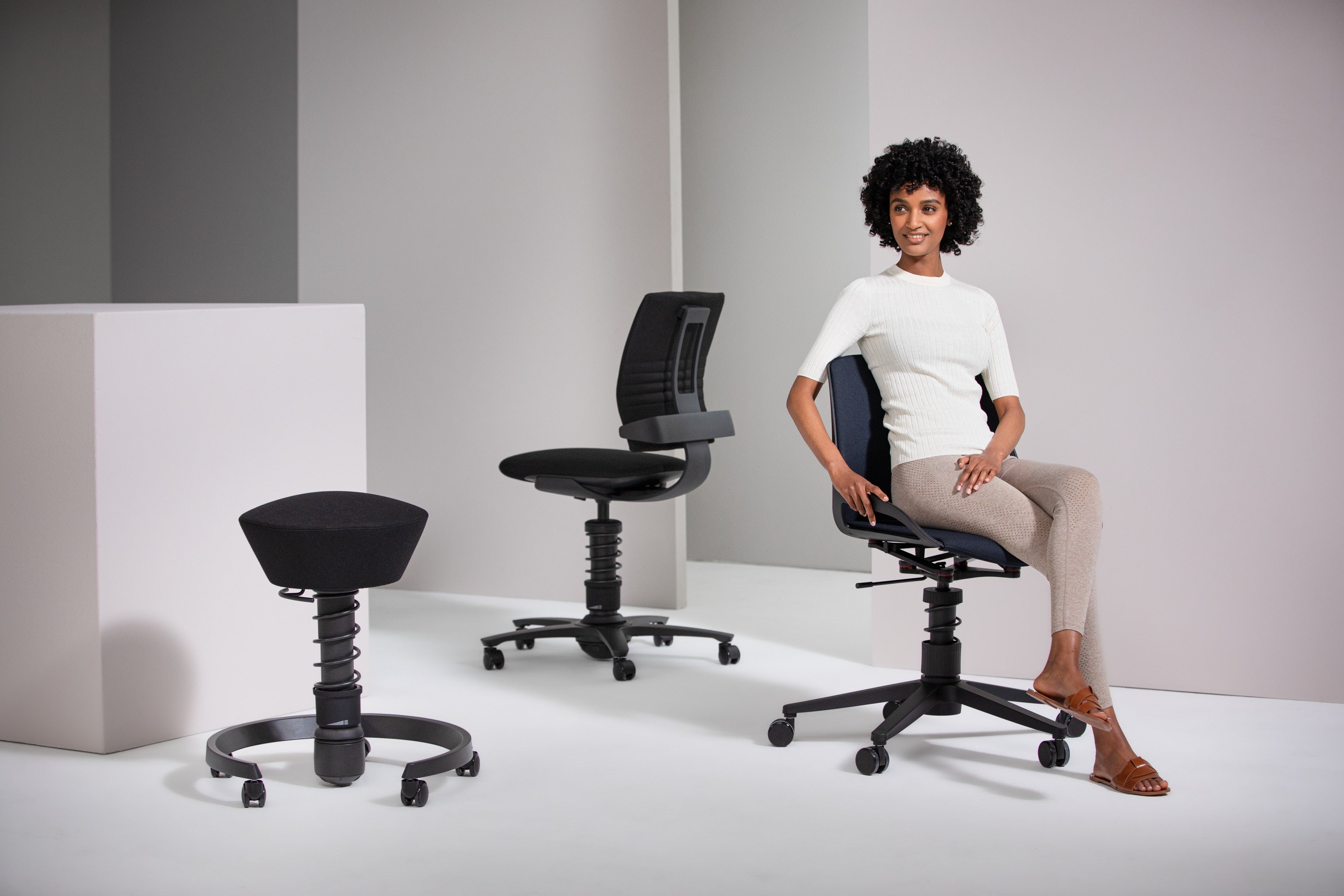
3D technology means that movement is possible in three dimensions: forwards and backwards, sideways, and up and down. Upright and changing sitting positions thus occur naturally.
And that's good for the intervertebral discs and also trains the muscles, especially the back muscles, which in turn stabilizes the spine.
By using active office chairs to continuously incorporate movement into your sitting, you also prevent poor posture and postural damage such as a rounded back. Here you will find an overview of all ergonomic office chairs from Aeris that combine movement, design, and health.
Disclaimer: Please note that we are not doctors and do not offer medical advice. The content of this post is for general information purposes only and cannot replace a professional medical diagnosis and treatment. If you have any doubts or questions, always consult your doctor.